
Saturday, March 22, 2003
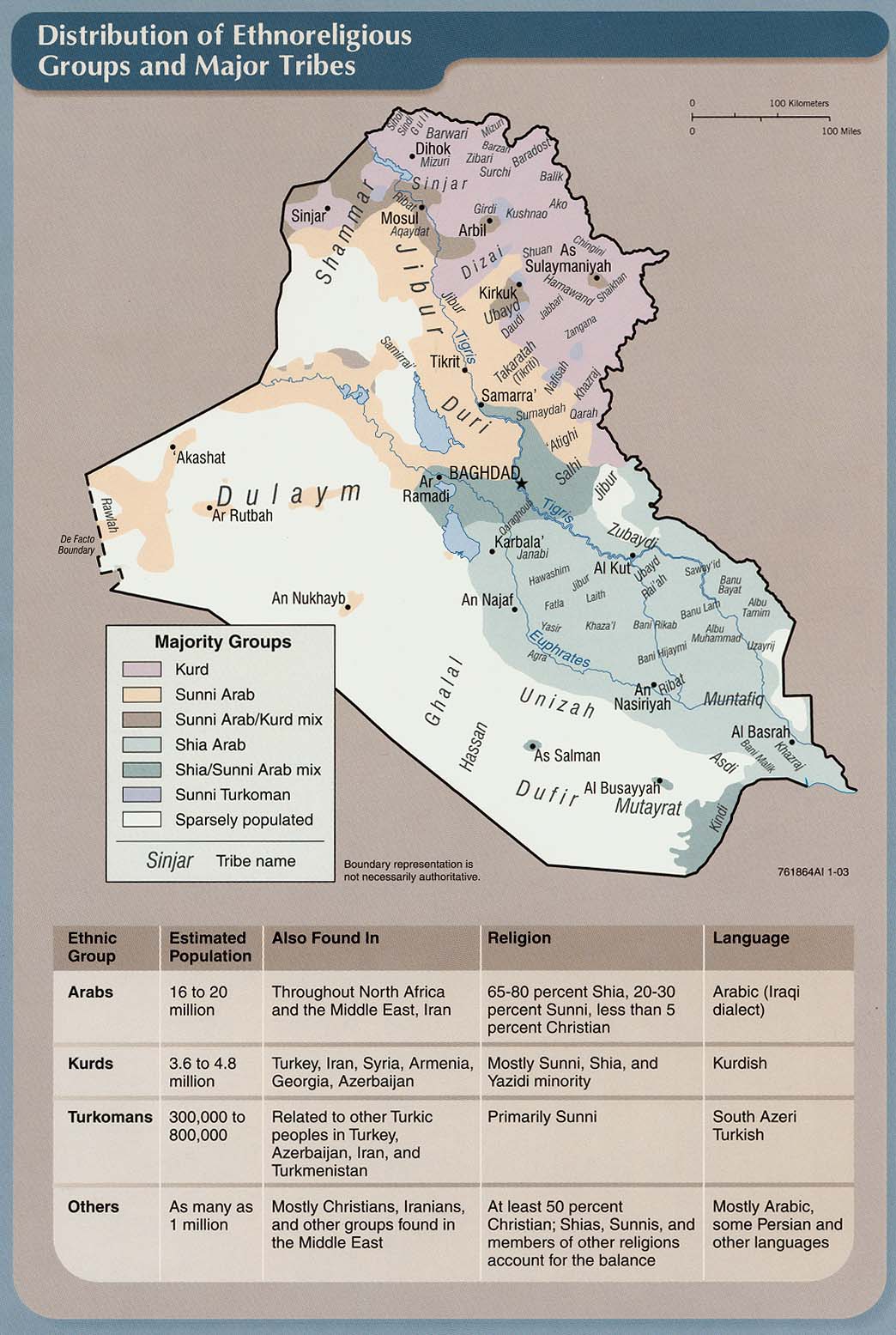
I found a map illustrating the ethnic distribution in Iraq, in the University of Texas Perry-Casta?eda Library
 </Aurelius> <!--4:08 PM-->
Rumsfeld Says Iraq Is Collapsing, Lists 8 Objectives of War [NYT, 03/22/03]
Secretary of Defense, Donald Rumsfeld announced eight goals of the US in Iraq. As follows:
- "The first of the eight specific aims, Mr. Rumsfeld said, is to "end the regime of Saddam Hussein by striking with force on a scope and scale that makes clear to Iraqis that he and his regime are finished."
- Second, Iraq's arsenal of biological and chemical weapons, and any program to develop nuclear weapons, are also targets, as the American military has been ordered "to identify, isolate and eventually eliminate Iraq's weapons of mass destruction, their delivery systems, production capabilities, and distribution networks," Mr. Rumsfeld said.
- Troops will then "search for, capture, drive out terrorists who have found safe harbor in Iraq," he added.
- Next, he said, the allied forces will "collect such intelligence as we can find related to terrorist networks in Iraq and beyond."
- The fifth goal, Mr. Rumsfeld said, is to "collect such intelligence as we can find related to the global network of illicit weapons of mass destruction activity."
- The United States also seeks "to end sanctions and to immediately deliver humanitarian relief, food and medicine to the displaced and to the many needy Iraqi citizens," Mr. Rumsfeld said.
- Military forces also will "secure Iraq's oil fields and resources, which belong to the Iraqi people, and which they will need to develop their country after decades of neglect by the Iraqi regime," Mr. Rumsfeld said.
- Lastly, Mr. Rumsfeld said, the war effort is "to help the Iraqi people create the conditions for a rapid transition to a representative self-government that is not a threat to its neighbors and is committed to ensuring the territorial integrity of that country."
I'm glad to see the administration elucidating some goals for the war but I'm concerned that they aren't quantitative enough. The first goal to end the regime of Saddam Hussein avoids explicitly saying how to gauge that the "regime is finished." Is exile still an option for Saddam? The third and fourth points about terrorists and terrorist networks are both vague. And I'm not sure what the secretary means about a "global network of illicit weapons of mass destruction activity." One would hope that they already are doing that. In all, it gives the impression that the administration is thinking about what it's doing in Iraq, but I'd like to hear more specifics.
</Aurelius> <!--1:22 PM-->Today I'm following some news regarding Turkey. It started with a news item on Salon, "Turkey denies troop deployment in Iraq." Turkey had previously announced that it was sending 1,000 commandos into northern Iraq, a move that didn't seem to go over well with either the Americans or the Germans. So they reversed themselves and claimed that the previous report of troops entering Iraq was "a lie." Both reports seem to have been issued today.
Turkey was already in bad standing with the US for denying any assistance in the Iraqi invasion last month. Since the invasion began, Turkey has reversed itself, voting to grant overflight rights to the US on Friday, but it lost a an economic compensation package that was originally offered it by the US.
Turkey's main concern seems to be containing the Kurdish population of northern Iraq. There seems to be worry that Iraqi's Kurds may try to form a sovereign Kurdish state which would affect Turkey and its own large Kurdish population. I'm should look into the ethnic tensions of the Middle East more closely. What little I know: After the dissolving of the Ottoman Empire at the beginning of the 20th century (after WWI or WWII?) the Middle East was divided up by Britain and France into arbitrary states. In doing this, many ethnic groups were sorted and divided among the new states. This may have contributed to the current instability. The groups probably didn't get along all that well previously but any existing problems were probably amplified by the new situation. Now the existing state of Turkey is trying to protect itself an its borders in the wake of events in Iraq. But the US (and NATO) seems to be wary of that.
</Aurelius> <!--10:37 AM-->Friday, March 21, 2003
I'm not sure if I find this article, "Oil, intimidation, rage - why we are really at war" in the London Times heartening because it seems to offer a balanced assessment or because it simply justifies what I already feel.
I noticed a curious item tucked among all the war news in the Salon headlines, "U.S. Marines storm South Korean beach". It mentioned US military drills and wargames going on in South Korea . I'm a bit surprised to find that we have 37,000 troops in South Korea and that they'd be conducting wargames right now with tensions up with the North Koreans and the war in Iraq. I went to the BBC's article, "Pyongyang says US is planning attack" in the Asia-Pacific section for more info. The story didn't seem to make the Washington Post nor did it garner notice in the New York Times (it wasn't on the front of their Websites and casual digging in the International sections didn't turn it up.) The BBC article has a nice chronology of the ongoing situation with N. Korea and some promising links. Curious and curiouser...
</Aurelius> <!--9:37 AM-->Thursday, March 20, 2003
In my last entry, I mused about whether US forces would see evidence of chemical or biological weapons in use by the Iraqis. Joe Conason's journal entry (of 03/20/03) in Salon pointed me to this NY Times article, "U.S. Mobile Labs Are Poised to Hunt Iraqi Arms" about the Pentagon's plan to deploy tactical mobile exploitation teams (MET) to locate and survey possible weapon sites. The article was unclear about whether these were sites that were previously shared with UN inspectors but Conason suggests that the US wasn't very forthcoming about sharing the information.
</Aurelius> <!--2:53 PM-->I will be interested to see whether the Iraqis do use any chemical or biological weapons in the current conflict. If they do then the Bush administration was right all along. If they don't and the US doesn't recover any evidence of such, then we had no justification to go in there.
I'm also interested about the administration's threat to punish war crimes: "Do not destroy oil wells, a source of wealth that belongs to the Iraqi people. Do not obey any command to use weapons of mass destruction against anyone, including the Iraqi people. War crimes will be prosecuted. War criminals will be punished." I wonder who will be the ones to pass judgement on war crimes considering that the US doesn't agree with an International Criminal Court.
</Aurelius> <!--2:27 PM-->Also discovered an interesting Website, Fairness & Accuracy In Reporting. I like (so far) that they cite their sources. I should check their biases, though.
</Aurelius> <!--2:04 PM-->Found a possibly useful link on how to check sources. I should've taken a class like this in college.
</Aurelius> <!--2:00 PM-->Interesting article from The Economist contrasting the conditions faced by the two Bushes as they led the nation into war. Most interesting, to me, was the reference to W's changing justification for the war. He has touched, over the past months (and I'm sure to varying audiences,) on the need to enforce UN Security Council resolutions and the need to bring democracy to the Middle East but his latest speeches as we entered into the conflict revert to the doctrine of pre-emption.
I'm also intrigued by the numbers they're using about countries that support us. Yesterday (before the fighting started) the number of countries that publicly supported us was 35 with 15 others supporting us anonymously. I thought I heard Secretary of Defense, Donald Rumsfeld say this morning that that was more than the number that supported us in the first Gulf War but the articles states that 100 countries supported us in that war. And I'm unclear about what it means that we have their support. Are they supplying troops? Money? Lip service? I'm wary of the numbers.
</Aurelius> <!--1:11 PM-->That last post was a bit to cryptic. Some exposition is in order...
Today is the first day of the U.S.'s "military operations to disarm Iraq, to free its people and to defend the world from grave danger." I'm resigned to ambivalence. I don't want this war but I don't think this war could've been avoided. Too many factors drove us to this moment. The current administration had too much "resolve" for "regime change" in Iraq.
There are many layers of truth and I haven't sorted through them all. I don't know if I can ever understand them or come to terms with them. At this point, all I'm hoping to do is let them wash over me and find happiness for myself. Not a very active solution but this is not something that I would've chosen.
Here's hoping for the best...
</Aurelius> <!--9:34 AM-->And so it begins...
</Aurelius> <!--9:26 AM-->